
Resources
Learn more about the real-life history that inspired Gisele and the Northman.
FAQs
-
I was getting very confused as I read history books about Rollo (also known as Rolf and Rolf the Walker). Some historians stated their cases definitively. While others couched their writings with a healthy dose of skepticism.
I consulted helmerichs.us and essays by Robert Helmerichs and Emily Albu. They articulated what is known about Rollo based on evidence and what is myth and legend. I refer you to their website if you want to know more.
According to Helmerichs, there are three brief mentions of Rollo in contemporary sources:
The first was a 918 charter in which King Charles the Simple grants lands for an abbey, “…except for the part that we have given to the Northmen of the Seine, namely to Rollo…”
The other two mentions of Rollo were in The Annals of Flodoard of Reims 919-966 (I used the Fanning and Bachrach translation), one being in the year 925, where Count Arnulf and his men attacked the Northmen and Rollo responded by sending 1,000 soldiers from Rouen; and another in the year 928, where Rollo was holding Count Herbert’s son hostage until Herbert and other nobles committed themselves to King Charles.
A fourth indirect mention is found in “The Planctus for William Longsword”, which was a lament for Rollo’s son William, written circa 943. It states that: “This man [William] born in an overseas city to a father/Remaining in the error of the pagans/But to a mother dedicated to the nourishing faith…” (translation by Robert Helmerichs, available online).
-
That would be History of the Normans, by Dudo of St. Quentin. Dudo was a French scholar, a canon of the Catholic church, who was retained by Rollo’s descendants to write about the first dukes of Normandy. He completed the history circa 1020 CE.
The version of Dudo which I used was translated by Eric Christiansen, published by Boydell Press in 1998. Christiansen also provided an extensive introduction, as well as a very dense set of endnotes. Christiansen characterized Dudo’s writing in this way:
“…Enough can be deduced from the surviving contemporaneous sources to demonstrate that the history is all wrong, throughout the work… Dudo was not a reliable source for the early history of the Normans; nor did he know of any; nor do we.” (Christiansen, page xv)
At helmerichs.us, Emily Albu’s essay on Rollo as Literary Figure discusses how Dudo’s writing influenced later historians such as William of Jumieges, Robert of Torigni, and others. And so it went for the next millennium, each historian building on the writing of those who came before, but all of them eventually tracing the origins to Dudo.
-
Since I intended to write a fictional story about Rollo, I decided to use Dudo’s description of him: he was noble born; fair in body; seemly in appearance; courageous; a ready fighter; ferocious against his enemies; faithful to his friends; kindly, with humble manners; well-spoken and eloquent; just; shrewd; prudent; teachable in affairs; careful in keeping secrets; very wealthy; with a numerous following of warriors.
-
Regarding Popa, Dudo wrote that Rollo took Bayeux by force, tearing it to the ground, and carrying off captives and spoils. “Moreover, he was delighted to carry off with him a girl called Popa who was beautiful to look at…the daughter of the mighty prince Berenger; and he took her in marriage and begot a son by her, called William…” (Christiansen, pages 38-39)
Christiansen added an endnote (#174) to this passage, regarding Popa, “…Her identity, and that of her father, remain doubtful…”
When I read the passage about Popa, one thing stuck with me: the aspect of capture marriage. Capture marriage could imply elopement, where the father had not given his consent, and the couple ran off secretly. But that is not what Dudo described. Popa’s home and city had been overtaken violently, and she had been taken against her will.
-
Dudo wrote that, as part of the terms of Rollo’s treaty with King Charles, he married Gisla, daughter of the king. Rollo’s claim to the land, “in perpetuity”, rested on having offspring by Gisla. Dudo described her as: “tall enough, and her shape, we have heard is most rare…”. She was: lawfully born; a virgin; prudent and careful in public matters; pleasant and affable; very skilled in handiwork. (Christiansen, pages 46-47)
As I began to write, I was following right along with Dudo’s account, that Gisla was old enough to marry and Rollo’s long-term claim to the land was predicated on him having legal heirs with the king’s daughter. As I learned about King Charles the Simple, I realized that he was about 32 years old in the year 911. Okay, so fumbling through the math, his daughter Gisla would not be older than about 15 or 16. I kept on writing, based on that premise. Making her younger than that would just be…unthinkable. Then I read something about King Charles marrying his wife Frederuna in the year 907, which would make their children toddlers and babies in 911. Yikes! I was fumbling again. I considered making Gisla an illegitimate daughter of Charles the Simple, believing that would not change the story drastically.
It was those dense endnotes that unbound my storytelling. Endnote #199 cautions that: “Gisla is an obvious invention, but a remarkably successful one.” The origins of the tale can be traced to the year 882, when a woman named Gisla, daughter of King Lothair II, was betrothed to a Viking named Godefrid.
So if Gisla, daughter of Charles the Simple, was a fictional creation of Dudo, who borrowed from an older story about King Lothair’s daughter, it no longer mattered what age I made her or her status as a legitimate or illegitimate daughter.
-
Fans of the television series “Vikings” will no doubt recognize the characters Rollo and Gisla in my characters Rolf and Gisele. Some may not be aware that the story of their marriage is a thousand years old, dating to the writings of Dudo of St. Quentin.
I have watched the series; it is an amazing saga. But after reading Dudo’s History of the Normans, I saw the story differently. I wanted to set the events in their proper time frame. I perceived Rollo as older, still vigorous and strong, but perhaps weary of war. I depicted King Charles as a young ambitious king in his thirties when he made the treaty with Rollo. In a dream sequence, I have portrayed the heroism of Count Odo, a young nobleman who valiantly defended the island fortress of Paris in the year 886. I represented Odo’s brother Count Robert as a worthy adversary trying to assess if Rollo can be trusted. I included the clergy, who could be found in the many layers of government as advisors, chancellors, scribes, and diplomats.
I wanted to represent the women—the Frankish women whose names are lost to history—who intermarried with Viking men and bred a new race of people: the Normans.
Maps
-

West Frankia
A map of West Frankia, which existed from 843 to 987 and covered much of what is modern day France.
Map by Julie Witmer, Custom Map Design
-
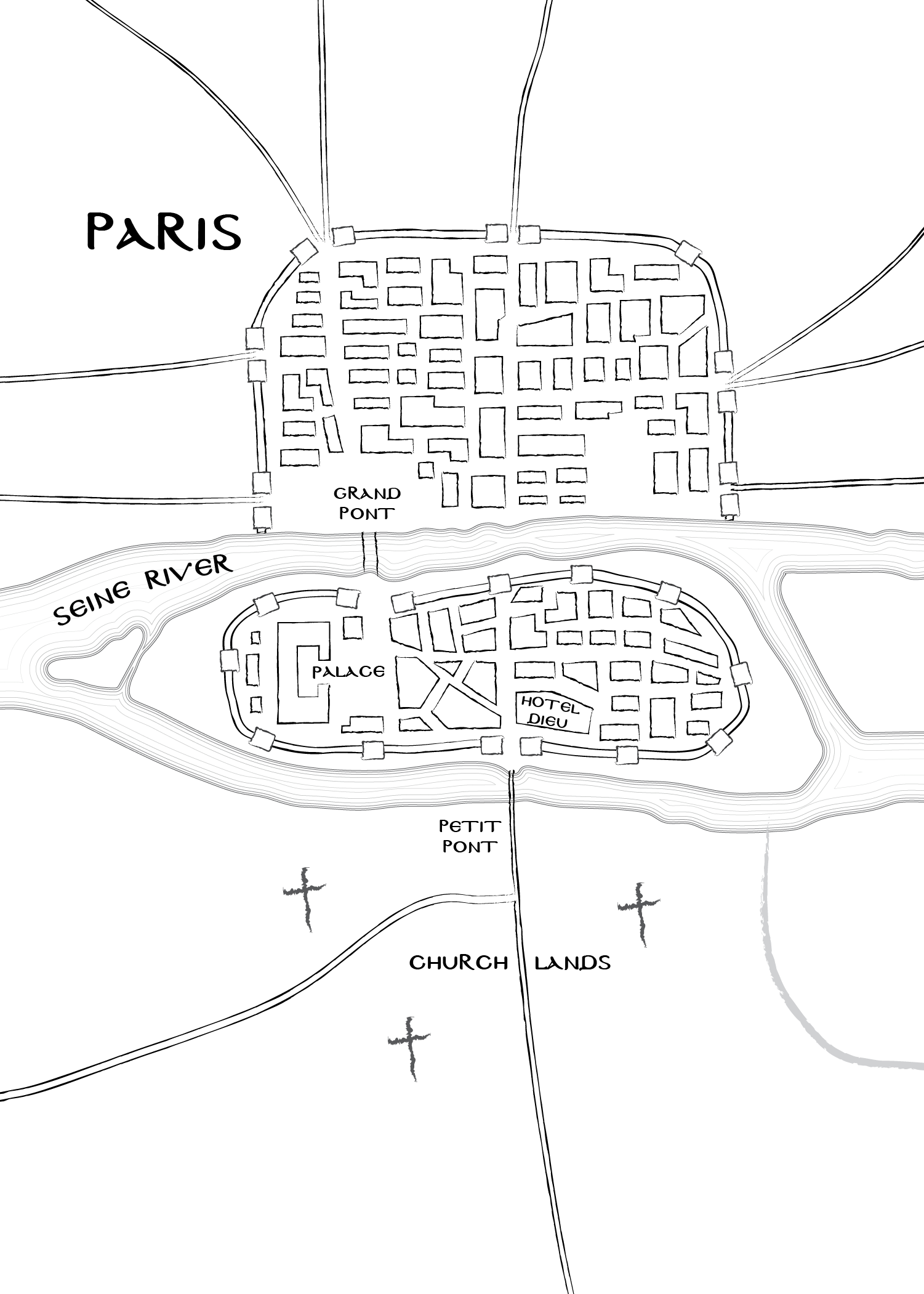
Paris (10th century)
A map of 10th century Paris with locations relevant to the story of Gisele and the Northman.
Map by Julie Witmer, Custom Map Design
Other Historical & Legendary Characters in the Book
Baldwin, II
Count of Flanders, a first cousin of King Charles the Simple. It is said that he arranged the murders of Archbishop Fulk of Reims, and Count Herbert I of Vermandois; he was married to a daughter of King Alfred the Great.
Béatrice
Countess of Paris, wife of Count Robert and sister of Herbert II, Count of Vermandois.
Beolin (Beollán)
An Irish prince who supposedly married Cadlinar, a daughter of Rollo (see Una).
Bernhard, the Dane
Mentioned several times in History of the Normans as being a supporter of Rollo’s son William and young grandson Richard.
Franco, Archbishop of Rouen
Christiansen notes in an end note (#159) that Archbishop Witto (aka Guy) of Rouen dealt with Rollo. Witto preceded Franco. The Wikipedia page on the Rouen Archdiocese is quite detailed, saying Wito served until 910 and Franco’s service in the role began in 911.
Hagano
Mentioned in Flodoard, was a minor nobleman who became a favorite of King Charles, causing Frankish nobles to grow angry with Charles and eventually abandon him.
Herbert, II, Count of Vermandois
His father’s assassination was arranged by Baldwin II. Herbert later held King Charles in captivity.
Hernekin
Supposed brother of Baldwin II of Flanders.
Herveus
Was Archbishop of Reims (900-922) and Archchancellor of West Frankia (910-919), supervising the royal notaries who handled the king’s documents.
Hugh
The son of Count Robert and Béatrice of Vermandois. Later called Hugh the Great, he was the progenitor of the line of Capetian kings of France.
Hugues, Count of Maine
I used the spelling Hugues to avoid confusion with Hugh the son of Count Robert. Count Hugues was a first cousin of King Charles the Simple.
Olof
Mentioned in History of the Vikings by Gwyn Jones, who wrote that, after 891, Olof seized power in Denmark from King Helgi.
Richard, Duke of Burgundy
Also called “the Justiciar”.
Robert, Count of Paris
Later King Robert I (922-923).
Úlfrinn
A pseudonym which I created for Rollo’s brother, Gurim, who was mentioned in Dudo.
Una
A character based on Cadlinar, supposed daughter of Rollo by a Scottish mother.
William
Son of Rollo.
Sources
Key Sources
Dudo of Saint Quentin, History of the Normans, translated by Eric Christiansen, Boydell Press, 1998. This book was the most influential source, providing many ideas and themes: Rollo’s character attributes—fair, courageous, just, shrewd, wealthy; he was a Dane, driven into exile by a tyrannous king; his brother died in battle; he was influenced by dreams; his battles in England; Rollo’s attacks along the Seine and other regions; the capture of Popa in Bayeux; Rollo splitting his army and himself leading the attack on Paris; the meeting at Saint Claire and Archbishop Franco’s address; Rollo balking at the treaty signing; offers of Flemish and Breton lands; the Frankish demand that Rollo kiss the king’s foot; the roguish Northman who laid the king on his back; Rollo’s baptism by triple immersion; Count Robert, his godfather; the siege and defeat at Chartres; Duke Richard’s stout defense of Chartres and his anger over the treaty with Northmen; the escape of the Northmen stranded on the hilltop; Rollo’s followers becoming land tenants; his competent management of affairs at Rouen; Count Robert conspiring against the king.
The Annals of Flodoard of Reims 919-966, edited and translated by Steven Fanning and Bernard S. Bachrach, Broadview Press, 2004. I learned about Frankish outrage over: Charles’ reluctance to dismiss Hagano, a minor nobleman whom the king elevated to power; the gift of a benefice to Hagano which had belonged to Charles’ aunt. With an introduction and endnotes, Fanning and Bachrach reviewed many aspects of the political situation in Frankia, including: the role of Archbishop Herveus; Baldwin’s use of assassination to eliminate opposition; the death of King Louis the Child in East Frankia and, subsequently, the Lotharingians switching their allegiance to Charles the Simple; the complicated familial relationships of all the various parties and their competing political interests.
General Histories
Davies, Norman, The Isles, 1999
Jones, Gwyn, History of the Vikings, 1984
Riché, Pierre, The Carolingians, a Family Who Forged Europe, translation by Michael Allen, 1993
Roesdahl, Else, Vikings, translation by Margeson and Williams, Third Edition, 2016
Roesdahl, Else, Viking Age Denmark, translation by Margeson and Williams, 1982
Books on Religion and Society in Medieval Europe:
Brundage, James, Law, Sex, and Christian Society in Medieval Europe, 1987
Bullough, Vern and James Brundage, editors, Handbook of Medieval Sexuality, 1996
Davidson, H.R.Ellis, Gods and Myths of Northern Europe, 1964
Gies, Frances and Joseph, Marriage and Family in the Middle Ages, 1987
Gies, Frances and Joseph, Women in the Middle Ages, 1978
Rosengarten, F., The Book of Spices, 1969
Academic Articles
Coupland, Simon, five articles: “Carolingian Arms and Armor”, Viator, Vol. 21, 1990; “Carolingian Army and the Struggle against Vikings”, Viator, Volume 35, 2004; “From Poachers to Gamekeepers: Scandinavian Warlords and Carolingian Kings”, Early Medieval Europe, 7(1), 1998; “The Rod of God’s Wrath, Carolingian Theology of the Viking Invasions”, Journal of Ecclesiastical History 42(04), 1991; “Vikings on the Continent in Myth and History”, History 88:290, 2003
Montgomery, James E., “Ibn Fadlan and the Rusiyyah”, Journal of Arabic and Islamic Studies, Volume 3, 2000
Online resources
Fulton, Michael, YouTube video on castle warfare
helmerichs.us, essays by Robert Helmerichs and Emily Albu
Keinath, Anthony, “Horticulture in Charlemagne’s Gardens”, updated 2016
MonreaghCentre YouTube video on the growing and harvesting of flax and the production of linen thread from its fibers
Physicians of Myddfai
“Planctus for William Longsword”, English translation by Robert Helmerichs
Viking Answer Lady website
Vlasaty, Tomas, “Scandinavian Helmets of the 10th century”
“The Wanderer”, a 10th century poem, English translation available at www.anglo-saxon.net